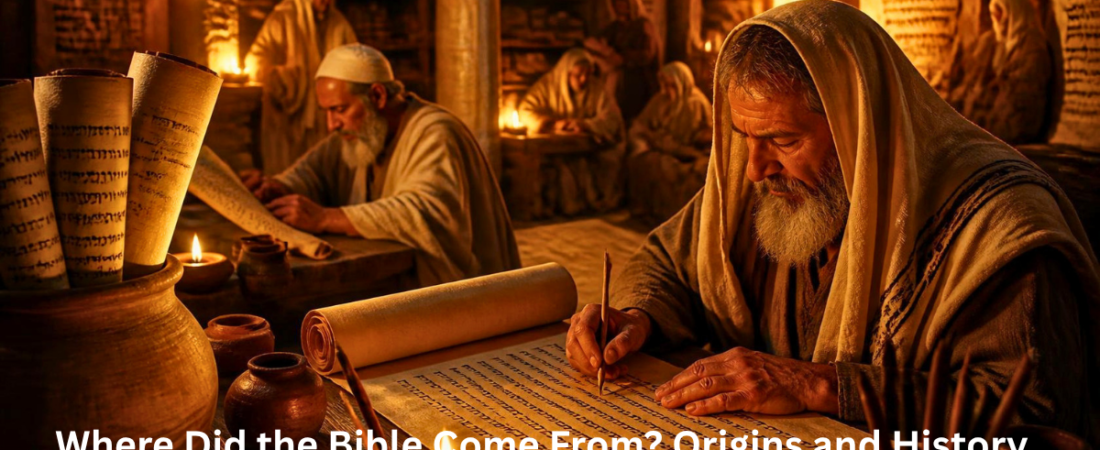
The Bible has shaped cultures, inspired billions of people, and influenced history for thousands of years. Yet one of the most common questions people ask is, where did the Bible come from? Some wonder whether it was written by one person, while others question if it has been changed over time or whether today’s Bible is the same as the original.
The answer is more fascinating than many realize. The Bible was written over many centuries by multiple authors in different locations, languages, and historical periods. Rather than being created all at once, it developed through a long process of writing, preserving, collecting, and recognizing sacred texts.
Understanding the Bible’s origin helps explain why Christians regard it as God’s Word while also appreciating the historical journey that brought these writings together into one book.
What Is the Bible?
The Bible is a collection of sacred writings central to the Christian faith. Instead of being a single book written at one time, it is a library of 66 books in most Protestant traditions, divided into the Old Testament and the New Testament.
The Old Testament records God’s relationship with Ancient Israel through history, law, poetry, wisdom literature, and the writings of the prophets. The New Testament focuses on the life, teachings, death, and resurrection of Jesus Christ, followed by the growth of the early Christian church.
These books include several literary styles, such as:
- Historical accounts
- Poetry and songs
- Prophecy
- Letters (Epistles)
- Wisdom literature
- Biographies of Jesus in the Gospels
Although written by different people over many generations, the Bible presents one continuous story of God’s relationship with humanity.
Where Did the Bible Come From?
The Bible originated in the ancient Near East, primarily in the regions of modern-day Israel, Palestine, and surrounding areas. Some portions were also written while God’s people lived in places such as Babylon and later within the Roman Empire.
Its writings span roughly 1,500 years, beginning with the earliest books of the Old Testament and concluding with the New Testament near the end of the first century AD.
Rather than appearing suddenly, the Bible developed through four major stages:
| Stage | What Happened |
| Writing | Inspired authors recorded God’s message during different historical periods. |
| Preservation | Scribes carefully copied manuscripts to preserve the text. |
| Collection | Individual books were gathered into recognized collections. |
| Canon Recognition | Faith communities formally recognized the books as authoritative Scripture. |
Understanding these stages helps distinguish between writing, compiling, and translating the Bible—three processes that are often confused.
Who Wrote the Bible?
One of the biggest misconceptions is that a single person wrote the Bible. In reality, approximately 40 authors contributed to its books over many centuries.
These writers came from diverse backgrounds, including:
- Shepherds
- Kings
- Prophets
- Priests
- Fishermen
- Tax collectors
- Physicians
- Tentmakers
Some of the best-known biblical authors include:
| Author | Notable Contribution |
| Moses | Traditionally associated with the Torah or Pentateuch, including Genesis through Deuteronomy. |
| David | Many of the Psalms. |
| Isaiah | The Book of Isaiah. |
| Jeremiah | Jeremiah and Lamentations. |
| Matthew | Gospel of Matthew. |
| Mark | Gospel of Mark. |
| Luke | Gospel of Luke and Acts. |
| John | Gospel of John, three letters, and Revelation. |
| Paul | Numerous New Testament Epistles. |
| Peter | First and Second Peter. |
Although each writer had a unique style and historical setting, Christians believe these books together communicate a unified message.
When Was the Bible Written?
The Bible was written over approximately 15 centuries, making it one of the longest literary projects in history.S
Old Testament Timeline
Most of the Old Testament was written between approximately 1400 BC and 400 BC.
During this period, God’s people experienced events including:
- The Exodus from Egypt
- Settlement in the Promised Land
- The reigns of King David and King Solomon
- Division of Israel and Judah
- Exile in Babylon
- Return to Jerusalem
The prophets—including Isaiah and Jeremiah—addressed these historical events while calling people back to faithful living.
New Testament Timeline
The New Testament was written much later, primarily between AD 45 and AD 100.
Its books record:
- The ministry of Jesus Christ
- His crucifixion and resurrection
- The growth of Christianity across the Roman Empire
- The ministry of the Apostles
- Letters sent to early churches
By the end of the first century, the core New Testament writings had already circulated among Christian communities.
What Languages Was the Bible Originally Written In?
The original biblical writings were not written in English. Instead, they were composed in three ancient languages.
| Language | Primary Use |
| Hebrew | Most of the Old Testament |
| Aramaic | Portions of Daniel, Ezra, and a few other passages |
| Greek | Entire New Testament |
Hebrew served as the primary language of Ancient Israel. Aramaic became widely spoken during later Old Testament history, while Koine Greek was the common language throughout much of the Roman Empire when the New Testament was written.
Because modern readers speak many different languages, scholars translate these original texts into today’s Bible versions while working from the oldest available manuscripts.
How Were the Original Manuscripts Preserved?
Before printing presses existed, every biblical manuscript had to be copied by hand. This responsibility fell largely to highly trained scribes who followed careful copying practices designed to reduce mistakes.
Over time, thousands of biblical manuscripts were produced and distributed across different regions. These copies allow scholars to compare texts from various places and time periods, helping identify minor copying variations while confirming the remarkable consistency of the overall message.
Among the most significant discoveries are the Dead Sea Scrolls, found near the Dead Sea in the mid-20th century. Dating from centuries before Christ, these manuscripts include portions of the Hebrew Bible and demonstrate that many Old Testament texts were preserved with remarkable accuracy across long periods.
Other important manuscript witnesses include the Codex Sinaiticus and Codex Vaticanus, two of the oldest surviving complete collections of Christian Scripture. Alongside ancient translations such as the Septuagint and the traditional Masoretic Text, these sources provide valuable evidence for understanding the transmission and preservation of the biblical text.
These manuscript discoveries not only illuminate biblical history but also help readers distinguish between the original writings, later copies, and modern translations—an important distinction that is often overlooked.
How Was the Bible Compiled?
The Bible did not become a single volume overnight. Individual books were first written for specific audiences and preserved by communities that recognized their spiritual and historical importance. Over time, these writings were collected into the two sections now known as the Old and New Testaments.
Understanding the writing process of the Bible helps distinguish between the original writings, later copies, and modern translations.
The Old Testament was already recognized as sacred Scripture within the Jewish community before the time of Jesus. The Torah, or Pentateuch, formed its foundation, followed by the historical books, wisdom literature, and the writings of the prophets.
The New Testament developed as the Gospels, Epistles, and other apostolic writings circulated among early Christian churches. Church leaders carefully examined these books to determine whether they reflected authentic apostolic teaching and were widely accepted by believers.
How Was the Biblical Canon Formed?
The term biblical canon refers to the collection of books officially recognized as inspired Scripture. Contrary to a common misconception, church leaders did not invent these books centuries later. Instead, they recognized writings that had already been accepted and used by Christian communities.
Several factors guided this recognition:
- Connection to the apostles or their close companions.
- Consistency with established Christian teaching.
- Widespread use in churches.
- Evidence of spiritual authority and faithful transmission.
The process took place gradually during the first few centuries of Christianity, helping preserve a consistent body of Christian Scripture for future generations.
Why Are There Different Bible Versions?
Many people assume different Bible versions contain different messages, but most differences are related to translation style rather than doctrine.
Modern translations are based on the oldest available biblical manuscripts, including the Masoretic Text, Septuagint, Codex Sinaiticus, and Codex Vaticanus.
Translation teams balance two main approaches:
- Word-for-word translation, which stays close to the original wording.
- Thought-for-thought translation, which emphasizes natural readability.
This explains why versions such as the KJV, NKJV, NIV, and ESV may use different wording while communicating the same core message.
Has the Bible Changed Over Time?
One of the most frequently asked questions is whether today’s Bible is different from the original writings.
The original manuscripts no longer exist, but thousands of ancient copies allow scholars to compare texts across centuries. Most differences involve spelling, grammar, or word order rather than major teachings. Through textual comparison, researchers can identify copying variations with a high degree of confidence.
For this reason, historians generally distinguish between copying, translation, and rewriting. While translations continue to improve as language evolves, there is no historical evidence that the central message of the Bible was intentionally rewritten or replaced.
What Evidence Supports the Bible’s Reliability?
No historical document should be accepted without examination, and the Bible has been studied more extensively than almost any other ancient text.
Several factors contribute to its historical reliability:
- Thousands of surviving manuscripts from different periods.
- Discoveries such as the Dead Sea Scrolls, which confirm the preservation of many Old Testament texts.
- References to biblical people, places, and events supported by biblical archaeology.
- Independent historical writings that mention early Christianity and key biblical figures.
- Consistent manuscript evidence preserved across centuries.
These sources do not answer every theological question, but they provide a strong historical foundation for understanding how the Bible has been transmitted through history.
Common Misconceptions About the Bible
Many questions arise because writing, compilation, and translation are often confused.
Myth: One person wrote the Bible.
Fact: Around 40 authors contributed over roughly 1,500 years.
Myth: Emperor Constantine created the Bible.
Fact: The biblical books already existed long before Constantine’s reign.
Myth: Every Bible translation is completely different.
Fact: Most translations communicate the same core message while using different translation methods.
Myth: The Bible was repeatedly rewritten.
Fact: Ancient manuscripts allow scholars to compare copies and identify minor textual variations while preserving the original message.
Why the Bible Still Matters Today
For Christians, the Bible is more than an ancient historical document. It serves as a guide for faith, worship, prayer, and daily living.
Its teachings continue to influence personal values, family life, ethics, education, literature, and culture around the world. Whether someone approaches the Bible from a historical perspective or a spiritual one, understanding its origin provides valuable insight into one of history’s most influential books.
If you’re beginning your journey, learning to study the Bible for spiritual growth can help you better understand its message and apply its teachings in everyday life. You can also deepen your faith through articles on How to Pray According to the Bible, Building Stronger Faith Through Scripture, Applying Biblical Wisdom Daily, and Growing Closer to God Every Day.
FAQ’s
Q: Where is the Bible originally from?
The Bible originated in the ancient Near East, primarily in present-day Israel and nearby regions. Its books were written over many centuries in different historical settings.
Q: Who wrote the Bible and where?
Approximately 40 authors—including Moses, David, Isaiah, Jeremiah, Matthew, Mark, Luke, John, Peter, and Paul—wrote the Bible in locations across Ancient Israel, Babylon, Asia Minor, Greece, and the Roman Empire.
Q: Is the Bible 100% true?
Christians believe the Bible is God’s inspired Word and completely trustworthy in what it teaches. Historians also recognize it as an important collection of ancient documents supported by substantial manuscript evidence and archaeological discoveries.
Q: What language was the Bible first written in?
Most of the Old Testament was written in Hebrew, with some sections in Aramaic, while the New Testament was written in Koine Greek.
Q: How was the Bible compiled?
Individual books were written, preserved, copied, and circulated before being recognized as part of the biblical canon by Jewish and early Christian communities.
Q: Why are there different Bible translations?
Different translations aim to make the original Hebrew, Aramaic, and Greek texts understandable for modern readers while using varying translation philosophies.
Q: What are the oldest Bible manuscripts?
Among the oldest and most significant are the Dead Sea Scrolls, Codex Sinaiticus, and Codex Vaticanus, which provide valuable evidence for the preservation of biblical texts.
Q: Has the Bible been changed over time?
Although handwritten copies contain minor variations, extensive manuscript evidence shows that the Bible’s essential teachings have remained remarkably consistent throughout history.
Conclusion
The answer to “Where did the Bible come from?” is both historical and spiritual. It was written by many authors over approximately 1,500 years, preserved through careful manuscript transmission, and recognized over time as the biblical canon. From the Torah and the Prophets to the Gospels and Epistles, the Bible reflects centuries of history while presenting a unified message that continues to shape lives today.
Whether you’re exploring Christianity for the first time or ready to start reading the Bible, understanding its history provides valuable context for every page you read.