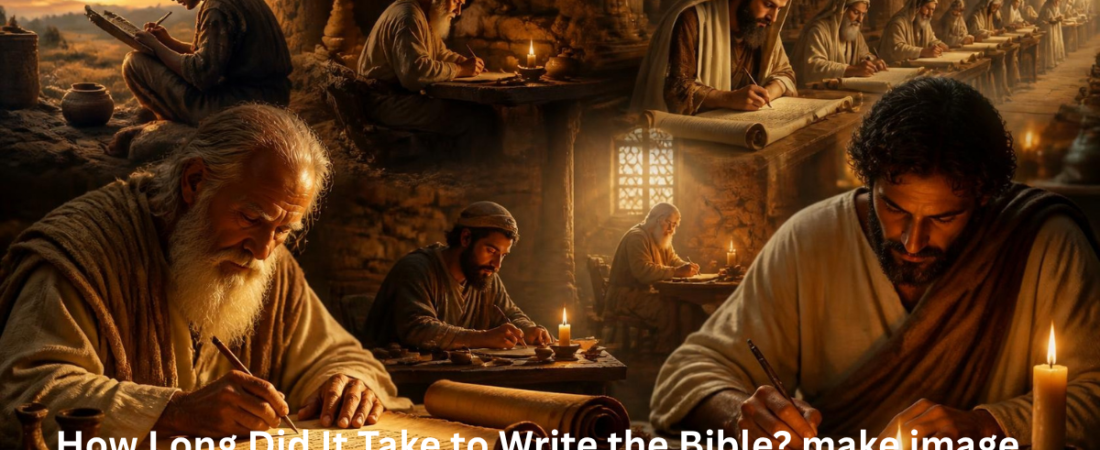
The Bible was written over approximately 1,500 years, beginning around 1400 BC with the writings traditionally attributed to Moses and concluding around AD 95 with the Book of Revelation, written by the Apostle John. More than 40 human authors contributed to its 66 books, yet together they present a unified story of God’s relationship with humanity.
Understanding how long it took to write the Bible helps explain its historical depth, literary diversity, and enduring significance. It also answers common questions about who wrote the Bible, why the writing process lasted so long, and how Scripture remained consistent across many generations.
How Many Years Did It Take to Write the Bible?
Most biblical scholars and historians agree that the Bible was written over roughly 1,500 years. Some sources round this figure to 1,600 years, but the exact number depends on the dating of the earliest Old Testament writings and the final New Testament books.
The writing process spans two major sections:
- Old Testament: Approximately 1400 BC to 400 BC
- New Testament: Approximately AD 45 to AD 95
Rather than being written all at once, the Bible was recorded gradually as God worked through different people during different historical periods.
Bible Writing Timeline
The following timeline provides a simplified overview of when the Bible was written.
| Period | Approximate Dates | Key Events |
| Early Old Testament | Around 1400 BC | Moses records the Law and the Pentateuch (Torah) |
| Israel’s Kingdom | 1000–900 BC | David writes many Psalms, Solomon contributes Proverbs, Ecclesiastes, and Song of Songs |
| Prophetic Era | 800–400 BC | Isaiah, Jeremiah, Ezekiel, Daniel, and the Minor Prophets record God’s messages |
| New Testament Begins | AD 45–60 | Paul’s epistles and several early Christian writings are completed |
| Gospels | AD 60–90 | Matthew, Mark, Luke, and John document the life of Jesus Christ |
| Final Book | Around AD 95 | John writes the Book of Revelation |
Although these books were written centuries apart, they build upon one another and share the central theme of God’s plan for redemption.
Who Wrote the Bible?
The Bible was written by more than 40 human authors from a wide range of backgrounds.
These included:
- Shepherds
- Kings
- Prophets
- Priests
- Fishermen
- Tax collectors
- Physicians
- Religious leaders
Some of the best-known biblical authors include:
- Moses
- David
- Solomon
- Isaiah
- Jeremiah
- Ezekiel
- Daniel
- Ezra
- Matthew
- Mark
- Luke
- John
- Paul
- Peter
- James
- Jude
Christians believe these writers were inspired by God while still writing in their own language, style, and historical context.
How Many People Did God Use to Write the Bible?
While the exact number cannot be stated with complete certainty because a few books have debated authorship, the traditional answer is over 40 authors.
These writers lived across:
- Three continents
- Multiple kingdoms and empires
- Different cultures
- Different occupations
- About fifteen centuries of history
Despite these differences, the books consistently develop themes such as creation, covenant, redemption, faith, grace, and God’s kingdom.
Who Wrote the 66 Books of the Bible?
The Protestant Bible contains 66 books divided into:
- 39 books in the Old Testament
- 27 books in the New Testament
Some books clearly identify their authors, while others are traditionally attributed based on historical evidence and early church testimony.
Examples include:
- Genesis through Deuteronomy: Traditionally attributed to Moses
- Psalms: Primarily David, with contributions from others
- Proverbs: Mostly Solomon
- Isaiah: Isaiah
- Jeremiah: Jeremiah
- Luke and Acts: Luke
- Romans through Philemon: Paul
- Revelation: John
A few books, such as Hebrews, have uncertain authorship, though this does not affect their longstanding place within the biblical canon.
Why Did Writing the Bible Take So Long?
Many people wonder why God did not reveal the entire Bible at one time.
The answer lies in how biblical history unfolded. Scripture records God’s interaction with humanity across generations rather than describing a single event.
Several factors contributed to the lengthy writing process:
- God’s revelation unfolded progressively throughout history.
- Different prophets and apostles served at different times.
- Historical events needed to occur before they could be recorded.
- Jesus’ life, death, and resurrection happened centuries after the Old Testament.
- Early Christian churches received letters addressing real situations as Christianity spread throughout the Roman Empire.
Instead of one continuous writing project, the Bible reflects God’s work through many generations.
How Did One Message Stay Consistent Across So Many Authors?
One of the Bible’s most remarkable features is its consistent storyline despite having many contributors.
Its central message follows a clear progression:
- Creation
- Humanity’s fall into sin
- God’s covenant with His people
- The promises delivered through the prophets
- Jesus Christ’s life, death, and resurrection
- The growth of the early church
- The promise of God’s eternal kingdom
Although each author emphasized different events and audiences, these writings complement rather than contradict one another on the Bible’s core message. Throughout these books, readers can also see how different themes of hope in the Bible point to God’s promises and His plan of redemption from beginning to end.
Did It Really Take Around 1,600 Years to Write the Bible?
Yes—this statement is generally accurate, although 1,500 years is the figure most commonly used.
The slight variation comes from differing scholarly estimates for:
- The earliest biblical writings
- The dating of Moses’ lifetime
- The completion of Revelation
- Historical chronology
Whether someone says 1,500 or 1,600 years, both descriptions refer to the same broad historical period.
How Was the Bible Preserved?
Considering the Bible was written long before the invention of the printing press, many readers wonder how it survived.
Scripture was preserved through generations of careful copying by trained scribes. Over time, thousands of biblical manuscripts were produced in Hebrew, Aramaic, and Greek.
Important discoveries, including the Dead Sea Scrolls, have shown that many Old Testament texts remained remarkably consistent over centuries of transmission. Early translations such as the Septuagint also provide valuable evidence for the preservation of biblical writings.
While modern Bible translations differ in wording because of language and translation philosophy, they are based on ancient manuscript evidence rather than newly invented texts.
Common Misunderstandings About Bible Authorship
Several myths continue to circulate about how the Bible was written.
Myth: One person wrote the entire Bible.
Fact: More than 40 authors contributed over many centuries.
Myth: The Bible was written in only a few years.
Fact: The writing process lasted approximately 1,500 years.
Myth: The Bible was randomly assembled.
Fact: The biblical canon developed over time as God’s people recognized books that were accepted as inspired Scripture.
Myth: The Bible has been completely rewritten.
Fact: Ancient manuscripts provide strong evidence that the biblical text has been carefully preserved throughout history.
Why Understanding the Bible’s Timeline Matters
Knowing when and how the Bible was written helps readers appreciate its historical setting and literary richness.
It also explains:
- Why different writing styles appear throughout Scripture.
- How prophecy connects with later fulfillment.
- Why historical context matters when studying biblical passages.
- How the Old and New Testaments come together to tell one unified story.
For those new to Scripture, understanding where to start reading the Bible can make it easier to connect the historical timeline with the overall message of God’s Word.
FAQ’s
Q: How long did it take to write the Bible?
The Bible was written over approximately 1,500 years, from around 1400 BC to about AD 95.
Q: Did it take 1,600 years to write the Bible?
Many people say 1,600 years, while others say 1,500 years. Both figures describe roughly the same historical timeframe based on different scholarly estimates.
Q: Who wrote the Bible?
More than 40 human authors wrote the Bible, including Moses, David, Solomon, Isaiah, Matthew, Luke, Paul, Peter, and John.
Q: How many people did God use to write the Bible?
The traditional answer is over 40 authors, though the authorship of a few books remains uncertain.
Q: Who wrote the 66 books of the Bible?
The 66 books were written by numerous prophets, kings, apostles, and other servants of God over many centuries. No single person wrote every book.
Q: Why did writing the Bible take so long?
The Bible records God’s work across many generations. Its books were written as historical events unfolded and as God’s revelation was progressively given through prophets and apostles.
Q: How was the Bible preserved before printing?
The biblical text was preserved through careful manuscript copying, early translations, and the dedication of scribes. Archaeological discoveries such as the Dead Sea Scrolls support the reliability of this transmission.
Conclusion
The Bible was written over approximately 1,500 years by more than 40 authors, yet it presents a unified account of God’s relationship with humanity from Genesis to Revelation. Understanding its writing timeline, authors, historical background, and preservation offers valuable insight into why Scripture has remained central to the Christian faith for centuries. Whether you are beginning your Bible study journey or exploring biblical history more deeply, knowing how the Bible came together provides a stronger foundation for reading and understanding its message.